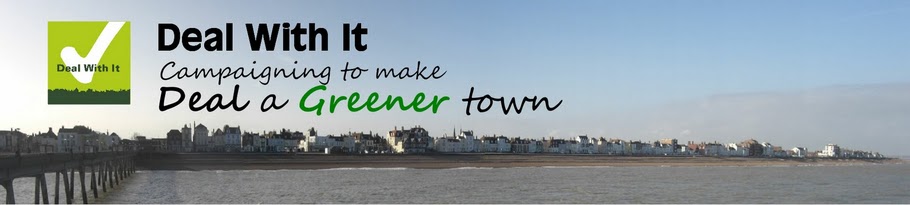
There was a great view of seven trawlers parading in front of the pier today in Deal.
It reminded us what a thriving local fishery looks like and what we used to have here in Deal. Unfortunately, in this case its appears that the spectacle is only only skin deep.
This was not not an 'Hugh's Fish Fight' example of a local fishing fleet responding to a local seasonal abundance but a commercial fleet from Kings Lyn literally hovering the mussel beds systematically in the Channel for foreign export.
According to local fishermen on Deal beach this fleet have been doing this for the past two months in the Channel.
We need a sustainable fishery here in East Kent and it is available - You can buy locally fished Sprats this weekend straight off Deal Beach and in our two fishmongers you will find fish caught around the Kent Coast.
Showing posts with label fish. Show all posts
Saturday, January 14, 2012
Thursday, August 4, 2011
Victoria's Green Matters 3rd August 2011
There was good news from the European Union (EU) last week that the Common Fisheries Policy (CFP) practice of discarding healthy fish at sea is to be phased out and long-term plans established to ensure that fish stocks become healthy for future generations. Fish discards have been the subject of a campaign, ‘Hugh’s Fish Fight’, by TV personality, Hugh Fearnley-Whittingstall, which highlighted the continuing obscenity of throwing away perfectly good food because the fisherman had exceeded his quota or had caught fish outside his quota.
The EU fisheries chief, Maria Damanaki, has said that action is needed now and she wants to ensure that fish stocks are at sustainable levels by 2015. This poses something of a problem because most fish stocks in Europe are already overfished. Recent academic studies have suggested that present fish stocks are less than 10% of post-war levels. This is because Europe’s fishing fleet is too large and has been overfishing for many years. There will be opposition from fishing groups that feel that they will be penalised under new rules but it is imperative that fish stocks are kept healthy and productive for the future.
The new proposals will include targets and time frames to stop overfishing and ways that enable fishermen to trade their quotas. Some fishermen will be able to leave the industry if they wish and there will be support for small fisheries. Plans also include decision making being devolved from Brussels to the regions, which will please many who fear the bureaucracy of the European Commission.
But these proposals are just proposals and many people have to agree to them before they are put in place. There is urgent need to reform our fishing industry so that we can support the jobs and communities that rely on it and ensure fish stocks for years to come.
Monday, April 18, 2011
First Transition Town to be backed by a Fish & Chip shop
Deal With It - Deal's local #transitioninitiative is probably the first Transition Town worldwide to be endorsed by a local fish & chip shop!
The 'Blue Mermaid Fish Bar' in Victoria Rd Deal has shown its appreciation of our support in its local 'Big Fish Fight' to try to use locally caught fish from Deal Beach by giving us a free advert on its new street sign.
Thank you Sam!
The 'Blue Mermaid Fish Bar' in Victoria Rd Deal has shown its appreciation of our support in its local 'Big Fish Fight' to try to use locally caught fish from Deal Beach by giving us a free advert on its new street sign.
Thank you Sam!
Thursday, March 24, 2011
Hugh gives top fish award to Deal Chippie
Hugh's Big Fish Fight are so impressed by the response of Deal's Blue Mermaid Fish & Chip bar to offer Mackerel and other locally caught fish on the menu, that the TV chief has bestowed the high accolade of put the Blue Mermaid on the 'Mackerel Wall of Fame'
Sam Sidhu's restaurant in Victoria Rd is the latest of 12 chippie's to be awarded this honour.
The award is for those fish & chip shops going the extra mile for Hugh Fearnley-Whittingstall's Mackerel Mission - his campaign to get Britain to try some of the great native and sustainable fish we have in our waters.
To see the 'Wall of Fame' go to http://www.fishfight.net/wall-of-fame/
Sam Sidhu's restaurant in Victoria Rd is the latest of 12 chippie's to be awarded this honour.
The award is for those fish & chip shops going the extra mile for Hugh Fearnley-Whittingstall's Mackerel Mission - his campaign to get Britain to try some of the great native and sustainable fish we have in our waters.
To see the 'Wall of Fame' go to http://www.fishfight.net/wall-of-fame/
Sunday, January 30, 2011
Deal's Blue Mermaid back Hugh's Big Fish Fight
As you may have seen from the local press this week, one of our local chippy's has stepped up to the mark to support Hugh Fearnley-Whittingstall's Big Fish Fight.
The Blue Mermaid Fish Bar in Victoria Road, Deal has been selling locally sourced battered Mackerel since last last Thursday.
Owner Sam Sidhu said "the Mackerel has been selling well since Thursday. On Saturday we actually sold more Mackerel than Cod. It is proving to be very popular as a lunchtime snack and its got our customers talking about the issue"
Customers to the Blue Mermaid were also treated to free tasters of sprats fresh off the beach at Deal. Sam wants to make seasonal, local sourced fish part of his menu. He hopes to be selling locally fished Pollock from April onwards.
As Sam says "locally caught fish is more sustainable. Its better for the local economy as well as better quality and a cheaper meal to our customers".
Hugh's campaign against wasteful fish discards, getting people to try fish other than cod or tuna and getting Chippies to try something different like Mackerel has had a great impact nationally. So far over 632 thousand people have signed to support the campaign. http://www.fishfight.net/
Why not drop in the Blue Mermaid and try some Mackerel ? You can support the campaign locally by approaching your local cafe or chippie. You can find our Deal With It Poster here
The Blue Mermaid Fish Bar in Victoria Road, Deal has been selling locally sourced battered Mackerel since last last Thursday.
Owner Sam Sidhu said "the Mackerel has been selling well since Thursday. On Saturday we actually sold more Mackerel than Cod. It is proving to be very popular as a lunchtime snack and its got our customers talking about the issue"
Customers to the Blue Mermaid were also treated to free tasters of sprats fresh off the beach at Deal. Sam wants to make seasonal, local sourced fish part of his menu. He hopes to be selling locally fished Pollock from April onwards.
As Sam says "locally caught fish is more sustainable. Its better for the local economy as well as better quality and a cheaper meal to our customers".
![]() |
| Sam's sign in support of BFF |
Why not drop in the Blue Mermaid and try some Mackerel ? You can support the campaign locally by approaching your local cafe or chippie. You can find our Deal With It Poster here
Monday, January 17, 2011
Top 10… ways to eat fish sustainably
Great article from By Katharine Helmore from the Ecologist
But the effects of bycatch are just a small part of the problem. Overfishing has seen cod stocks decline by 86 per cent over the last century and bluefin tuna placed at risk of extinction. Between 20 and 100 million sharks are killed each year thanks to increased demand for shark fin soup and thousands more die in the purse seine nets used by tuna fishermen. And that’s not all. Aquaculture is one of the worst marine polluters and requires thousands of tons of fishmeal – mostly anchovies, herring and sprats – to sustain its farmed fish. Other species are transported long distances – snow crab from Alaska for example, or tilapia from Vietnam – creating an enormous carbon footprint.
Despite this, fish remains one of the world’s most popular foods. So can eating fish ever be sustainable? Here are our top 10 ways to make sure the fish you eat comes without a side order of guilt.
1. Choose your species carefully
The Marine Conservation Society website regularly updates a list of fish to avoid and fish that are fine to eat. Fish that are safe to buy include dab, pouting, organic, farmed salmon and hand-picked cockles, while conger eel, swordfish and plaice are all off the menu. If you must eat cod, make sure it comes from the north-east Arctic or eastern Baltic, where stocks are healthy.
2. Try something different
Buying a wide range of fish is crucial for maintaining current fish stocks and protecting dwindling species. Food writer and fishmonger, Mitch Tonks, warns that if everyone switches from one species to another, the marine balance will be further upset. ‘Gurnard has been championed for a while now,’ he says, ‘but in reality the landings of it are small in comparison to other species and its yield is very low. It is one of the most delicious fish in the sea but perhaps it should join the ranks of other good fish like sole rather than become the next big thing that we should be eating.’ Bruce Rennie, head chef at The Gurnard's Head in Cornwall also recommends buying bigger fillets, as smaller ones tend to come from immature fish. 'As a rule of thumb, if the fish are not big enough to have reproduced and contributed to their species, they should be avoided,' he says. 'It is negligent to eat fish that haven’t had a chance.'
3. Buy local, seasonal fish
Support your local fishermen. Not only does local have a smaller carbon footprint, it’s usually cheaper too. Mackerel is readily available throughout the year and isn’t endangered. Sardines and pilchard are abundant in the seas off the coast of Cornwall while sea bream and sea bass are available in the English Channel. Markets offer a wider and fresher variety of locally sourced fish than supermarkets. ‘Cod and skate are mostly caught this time of year,’ says Jonny Dunhill of Ramsgate fishmonger, Eddie Gilberts. ‘In the warmer months bass, mackerel, plaice and Dover sole are landed in large quantities.’
4. Find a good fishmonger
Your fishmonger is the best source of information on what’s in season and how the fish has been caught. Most good fishmongers will source their fish from sustainable fisheries and will be able to recommend different species to try. (PS Both our Fishmongers in Deal are supporting the campaign Ed)
5. Make sure it’s line caught
Poor labelling on supermarket shelves can mean finding line-caught fish can be like trying to find a needle in a haystack. Ask staff at the fish counter and leave it if they can't tell you exactly how the fish was caught. Avoid bigeye and bluefin tuna, both of which are endangered and opt for line or poll caught albacore or skipjack tuna. Greenpeace has released a supermarket league of the most ethically sourced tinned tuna with Sainsburys, Marks and Spencer and Waitrose at the top. Line-caught pollack, lythe, black bream, porgy and sea bream are among some of the best white fish alternatives to cod.
Support Hugh Fearnley-Whittingstall's Big Fish Fight by making sure that the fish you eat is ethically caught and sourced from sustainable fisheries
Fish - the way we consume it and the way we catch it - is a hot topic right now. Horrified by the way that the Common Fishing Policy (CFP) has resulted in around half of all fish caught in British waters being thrown back dead or dying, TV chef Hugh Fearnley-Whittingstall and a host of celebrity supporters have begun a campaign called Fish Fight to end the waste.But the effects of bycatch are just a small part of the problem. Overfishing has seen cod stocks decline by 86 per cent over the last century and bluefin tuna placed at risk of extinction. Between 20 and 100 million sharks are killed each year thanks to increased demand for shark fin soup and thousands more die in the purse seine nets used by tuna fishermen. And that’s not all. Aquaculture is one of the worst marine polluters and requires thousands of tons of fishmeal – mostly anchovies, herring and sprats – to sustain its farmed fish. Other species are transported long distances – snow crab from Alaska for example, or tilapia from Vietnam – creating an enormous carbon footprint.
Despite this, fish remains one of the world’s most popular foods. So can eating fish ever be sustainable? Here are our top 10 ways to make sure the fish you eat comes without a side order of guilt.
1. Choose your species carefully
The Marine Conservation Society website regularly updates a list of fish to avoid and fish that are fine to eat. Fish that are safe to buy include dab, pouting, organic, farmed salmon and hand-picked cockles, while conger eel, swordfish and plaice are all off the menu. If you must eat cod, make sure it comes from the north-east Arctic or eastern Baltic, where stocks are healthy.
2. Try something different
Buying a wide range of fish is crucial for maintaining current fish stocks and protecting dwindling species. Food writer and fishmonger, Mitch Tonks, warns that if everyone switches from one species to another, the marine balance will be further upset. ‘Gurnard has been championed for a while now,’ he says, ‘but in reality the landings of it are small in comparison to other species and its yield is very low. It is one of the most delicious fish in the sea but perhaps it should join the ranks of other good fish like sole rather than become the next big thing that we should be eating.’ Bruce Rennie, head chef at The Gurnard's Head in Cornwall also recommends buying bigger fillets, as smaller ones tend to come from immature fish. 'As a rule of thumb, if the fish are not big enough to have reproduced and contributed to their species, they should be avoided,' he says. 'It is negligent to eat fish that haven’t had a chance.'
3. Buy local, seasonal fish
Support your local fishermen. Not only does local have a smaller carbon footprint, it’s usually cheaper too. Mackerel is readily available throughout the year and isn’t endangered. Sardines and pilchard are abundant in the seas off the coast of Cornwall while sea bream and sea bass are available in the English Channel. Markets offer a wider and fresher variety of locally sourced fish than supermarkets. ‘Cod and skate are mostly caught this time of year,’ says Jonny Dunhill of Ramsgate fishmonger, Eddie Gilberts. ‘In the warmer months bass, mackerel, plaice and Dover sole are landed in large quantities.’
4. Find a good fishmonger
Your fishmonger is the best source of information on what’s in season and how the fish has been caught. Most good fishmongers will source their fish from sustainable fisheries and will be able to recommend different species to try. (PS Both our Fishmongers in Deal are supporting the campaign Ed)
5. Make sure it’s line caught
Poor labelling on supermarket shelves can mean finding line-caught fish can be like trying to find a needle in a haystack. Ask staff at the fish counter and leave it if they can't tell you exactly how the fish was caught. Avoid bigeye and bluefin tuna, both of which are endangered and opt for line or poll caught albacore or skipjack tuna. Greenpeace has released a supermarket league of the most ethically sourced tinned tuna with Sainsburys, Marks and Spencer and Waitrose at the top. Line-caught pollack, lythe, black bream, porgy and sea bream are among some of the best white fish alternatives to cod.
Saturday, January 15, 2011
Support Hugh's FishFight here in Deal
Why not get a poster up at home or ask you local cafe or Chippie to take one ?
You can download the PDF from here
Wednesday, January 12, 2011
Something fishy....
Two very successful campaigns underway:
(1) Hugh Fearnley-Whittingstall has made a plea for support for a campaign to try and stop wasteful fish discards.
Half of the fish caught in the North Sea is thrown back overboard dead due to the current quota system imposed by the EU Common Fisheries Policy.
The Fish Fight Campaign will officially launch with a broadcast of “Hugh’s Fish Fight” presented by Hugh Fearnley-Whittingstall in January 2011.
Thousands have already signed up to support the cause, and Client Earth is also on board.
If you are at all interested in the future of our oceans, and the future of fish as food, then please go to www.fishfight.net and check out phase 1 of the campaign.
2) Greenpeace's Tuna Campaign. As you may have read we were all set to take action against Tesco this weekend when the unexpected happened. We have produced a league table of the best and worst offenders against tuna (fishing with fish attraction devices, seine purse nets etc) and had identified that Tesco were the worst own-brand supplier. When Tesco learned of this, and that Greenpeace were preparing a nationwide weekend of direct action against them, they agreed to change all their own-brand tuna to rod and line by the end of 2012. Good for them. But it means our campaigning has to take a different tack. We will be doing it a bit differently but will now target Princes tuna in the hope of making them see the light.
The Tesco result is great news, it really shows that we can make a difference.http://www.greenpeace.org.uk/
(1) Hugh Fearnley-Whittingstall has made a plea for support for a campaign to try and stop wasteful fish discards.
Half of the fish caught in the North Sea is thrown back overboard dead due to the current quota system imposed by the EU Common Fisheries Policy.
The Fish Fight Campaign will officially launch with a broadcast of “Hugh’s Fish Fight” presented by Hugh Fearnley-Whittingstall in January 2011.
Thousands have already signed up to support the cause, and Client Earth is also on board.
If you are at all interested in the future of our oceans, and the future of fish as food, then please go to www.fishfight.net and check out phase 1 of the campaign.
2) Greenpeace's Tuna Campaign. As you may have read we were all set to take action against Tesco this weekend when the unexpected happened. We have produced a league table of the best and worst offenders against tuna (fishing with fish attraction devices, seine purse nets etc) and had identified that Tesco were the worst own-brand supplier. When Tesco learned of this, and that Greenpeace were preparing a nationwide weekend of direct action against them, they agreed to change all their own-brand tuna to rod and line by the end of 2012. Good for them. But it means our campaigning has to take a different tack. We will be doing it a bit differently but will now target Princes tuna in the hope of making them see the light.
The Tesco result is great news, it really shows that we can make a difference.http://www.greenpeace.org.uk/
Subscribe to:
Posts (Atom)